How I Work in a Dynamic
The basics
My submission isn’t a scene I step into. It’s a thread that runs through daily life. When it’s held properly, it doesn’t need to be intense or constant. It just needs to be present.
I function best when I know where I stand. Clear expectations, consistent rules, and a dominant leader who means what they say. That’s not a preference; it’s how my neurodivergent brain stays settled, and my submission stays alive. When that structure is in place, I don’t drift back into control mode. I stay where I belong.
The closest analogy I have is a really good PA. I anticipate, follow through, keep things running smoothly, and lift up the person I serve. The kink and the sex come with that. They’re the natural product of a dynamic that’s working, not the point of it.

Balance, not intensity
I’ve lived 24/7 ownership. In my twenties, I was a full-time slave for two years, and it was one of the best experiences of my life. I know what that end of the spectrum looks like, and I’m not afraid of it.
But I also know it doesn’t sustain in the long term. Total immersion eventually crowds out real life, and real life is where most of us actually live.
What I’m looking for is balance. Kink and everyday life sit together naturally. Rules and rituals that carry through the day without requiring either of us to be in the scene constantly. A dynamic that becomes part of how we live rather than something separate from it.
I work to your level, not mine. Whatever you want to build, I’ll meet it. But I’m not looking for intensity for its own sake. I’m looking for something real that lasts.
Day to day
Small things matter more than big scenes.
A rule that stays with me through the day. A clothing instruction that reminds me of who set it. Permission is asked for things, even when we’re not together. A check-in that tells me I’m still held.
These keep me in headspace without either of us having to work hard at it. When the thread is held, I don’t drift. I stay there.
Service is central to how I submit. Domestic tasks done to your standard. Meals are prepared and served for you first. Your space is looked after because it’s expected of me. Sexual service on demand without hesitation; make your pleasure my main focus. These aren’t chores. They’re how I show I’m yours, and I know where I happily belong.
Kink as regulation, not punishment
This is worth understanding because it’s quite specific to how my brain works.
For most people, kink is about pleasure, and it is that for me, too. But it’s also something else. Because of my neurodivergence, certain things that might look like punishment or intensity from the outside are actually regulating and pleasurable for me. They’re stims. They work with my brain rather than against it.
Bondage quiets my nervous system in a way almost nothing else does. The physical restriction gives my brain a single point of focus, and the noise stops. Spanking with a steady rhythm works like a metronome. It anchors me and brings me back when I’m scattered or dysregulated. Sensory restriction, blindfold, noise-cancelling headphones, and a gag strip away the overwhelm and let me settle.
These aren’t things I want because I’ve misbehaved. They’re things my brain
genuinely needs and responds to. They are a reward to me. Understanding that changes how they work in a dynamic. When you restrain me or use impact play, you’re not correcting me. You’re giving my brain what it needs to come back to itself.
That’s a meaningful thing to be able to offer someone.
What I’m drawn to
To be clear about what I enjoy:
Control and ownership. Ongoing control is more powerful for me than intense scenes. Rules, rituals, daily structure, accountability. The feeling of being held inside someone’s authority even when they’re not in the room is what I’m drawn to at the deepest level.
Orgasm control. When someone controls my release, they’re running a thread through my day. It keeps me thinking about them, aware of my place, connected to the dynamic even in ordinary moments. Denial, edging, and structured permission all work well. Chastity devices don’t work for me practically, but I don’t need them anyway. I’m extremely obedient and simply follow orders, which creates something better: a constant, unrelieved edge without any hardware required.
Contracts. Contracts work for me at a deep level. When something is signed and in place, the decision is made. There’s nothing left to negotiate or second-guess. That inevitability gives my autism a container to settle into, and once it has that, my ADHD is free to come out. The spontaneity, the risk, the fun, all of it runs better inside a structure that feels permanent.
Orders. A calm, direct command drops me straight into submission. No raised voice needed. Eye contact, my name, and then the instruction. My brain quiets. I stop overthinking and just obey. That’s the most settled I ever feel.
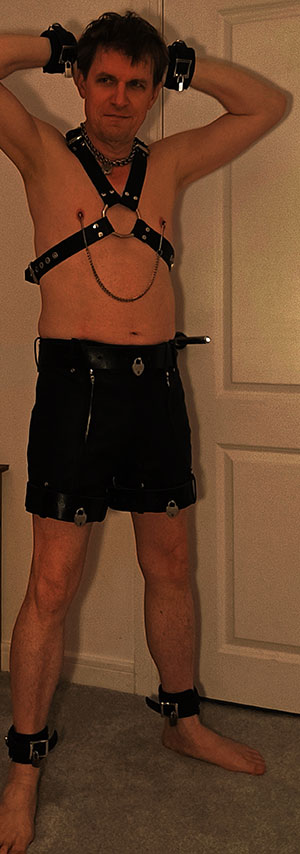
Bondage. A core need. Rope, leather cuffs, chains, and full body immobilisation. Being restrained tells me you’ve taken responsibility for me. It also genuinely helps when I’m dysregulated in ways that have nothing to do with play.
Spanking and impact play. Deep and reliable. Over the knee, bent over a bench. Hand, paddle, strap, cane. Light and playful through to firm and corrective. It grounds me, turns me on, and, when used consistently, serves as a reset for my nervous system.
Clothing control. What I wear, or don’t wear, keeps me thinking about you all day. Going commando. Something that reveals. Reporting that I’m following your rules. The right instruction in the morning means I never stop feeling your presence.
Nipple play. Directly wired to my arousal. Sensitive enough that the right touch bypasses everything else. Clamps are intense, but I’ll take them.
Fluid play (watersports). Part of how I experience ownership and being marked. Something I’m open about and happy to discuss properly when the time is right. I also understand it is not for everyone.

Psychological control. Your presence makes me want to obey without thinking. Hypnosis interests me. Repetition gets under my skin. Rules said over and over become the way I think. Language that makes me feel claimed and owned. You withhold approval until I’ve earned it, then give it in ways that make me ache for more. That’s how you get into my head and stay there.
How I work with you
I work to your level. You set the tone, and I meet it.
I do well with clear expectations and consistent follow-through. My brain works best when I know what’s expected rather than having to guess. Direct communication, even when it’s firm, is easier for me than vagueness or mixed signals.
I’m not looking to be constantly managed or corrected. I’m looking for someone who sets the frame and trusts me to operate inside it. When that’s in place, I don’t need chasing. I just get on with it.

How to correct me
Calm is more effective than force. Quiet expectation lands further than anything loud.
When I get too sharp, too independent, or start acting like I don’t need this, that’s a signal, not a cue to back off. Get closer. Wrap control around me again. That version of me is a mask. The submissive underneath responds to being claimed, not given space.
What works: a calm, firm instruction that expects immediate compliance. Physical reassertion. Getting closer, not pulling back.
What doesn’t work: silence as correction; it reads as punishment. Emotional withdrawal. Vagueness.
How my neurodivergence shows up in dynamics
My neurodivergence shapes how I submit in ways that are important to understand. I’m autistic and ADHD, and both sides show up differently depending on the dynamic, the energy, and the level of trust.
The autistic part of me likes clarity, structure, and predictability. I feel safest when expectations are explicit, and communication is direct. I don’t do well with guessing games or mixed signals. When I know the rules, I relax fully and give myself without hesitation. I’m loyal, consistent, and steady. I don’t mask in dynamics — what you see is what you get.
The ADHD part of me is almost the opposite. It’s impulsive, playful, curious, and thrives on tension and challenge. It loves being pushed, teased, surprised, and knocked slightly off balance. It’s where my energy, mischief, and risk‑hungry side live. This is the part of me that lights up in power exchange, that enjoys being directed, and that responds intensely to dynamic pressure.
I live in the pull between the two. Autism gives me depth, devotion, and stability. ADHD gives me spark, momentum, and heat.
Together, they mean I submit best when a dynamic is:
- clear enough for my autistic side to feel safe
- alive enough for my ADHD side to feel engaged
- structured enough to hold me
- playful enough to move me
- consistent, but not static
- firm, but not cold
When those pieces are in place, I’m fully present, responsive, and open. I don’t hold back. I don’t second‑guess. I give everything I have.
The surrender state. The deepest place I go is what I call acceptance submission. It’s the point where there’s no exit available, no variable left to manage, and my brain stops fighting the situation and starts living it. The autism settles because there’s nothing left to control. The ADHD embraces it fully because the outcome is already fixed.
That state can only come from submission. It has to be chosen first. But once I’m there, it’s one of the calmest and most grounded places I know. Predicament, bondage, contracts, rigged games; they all work partly because they remove the option to mentally step back out. That acceptance is its own headspace, and one of the deepest places I go.
Limits and trauma
My limits come partly from preference and partly from history. I have a trauma background, and I’m open about it. Far from it being something I shy away from, I’m actually reassured when someone asks. It tells me they’re taking it seriously.
The short version for now: nothing around my neck; no choking; collars are complicated for me (I love the look and symbolism of collars but struggle to wear them); best to avoid pressure around the neck. No scat, vomit, needles, or fire. No silent treatment used as punishment. I do have other limits, but those are the hard ones.
Body responses
My body doesn’t always reflect my headspace. I can get hard when I’m scared, triggered, or dissociated. An erection is not always consent or an invitation. If I go quiet or still during something, check in before continuing.
Safewords
I use the traffic light system.
Green means keep going, all is good. Amber means pause and check in with me. Red means stop everything immediately.
If I ask to write to you instead of speaking, that’s a sign I’m struggling to find words. Let me write.
Aftercare
After an intense session, my brain needs to come down gradually. What helps isn’t always soft and gentle in the conventional sense.
Quiet alone time works well for me. Cage time, where I’m enclosed and the world is reduced, can be genuinely settling. Being kept in light bondage with sensory restriction, blindfold, and headphones can help my brain reduce the overwhelm and process what just happened.
What I need most is to know I’m still held, that I did well, and that you’re near, even if you’re not right next to me. Once I’ve come back, I’ll let you know. Don’t rush that process.